


For as long as I can remember, I’ve been obsessed with UFOs, aliens, and otherworldly things. I can’t pinpoint where it began or why, but it’s been a staple of my curiosity from childhood to adulthood, and the fascination has only grown. I remember when the Time Life “Mysteries of the Unknown” books came out in the late 80s and early 90s, I was desperate to get my hands on them.
I found them in the library of my high school, which I would flock to nearly every day after lunch to peruse the section on the topic of all things unexplained. Those books were a portal for me, and I sought them out time and again until I finally purchased them many years later, along with nearly every UFO book I could get my hands on.
I tried reading Whitley Strieber’s “Communion” when I was younger, but it was too complex for me then. I saw Fire in the Sky at the movies and was mesmerized, eventually buying Travis Walton’s book of the account. Whatever I could find, I latched onto it, pored over it, and struggled to make sense of it. At one point, reading “Abduction” by John E. Mack, I had to stop.
I got to a point where I was too freaked out to continue. I was afraid to know any more than I had already gathered.
But I never stopped staring at the sky, even wishing for my own abduction at times. Not because I wanted to be molested by outer space creatures, but because I wanted to know the truth.
Is it all made-up nonsense? How could there be so many similar experiences from so many people? Why do they corroborate so many details? Is it a mental illness that people experience collectively? A cult? A government-sponsored conspiracy theory to distract the masses? Why can’t we get clearer images of these things? Why do so many doubt, while so many believe?
I could go on and on, but like The X-Files mantra, I wanted to believe.
Now, we’re living through a whole new era of actual disclosure, with U.S. government officials fighting for the truth to be revealed, people within the inside of these government and non-government entities testifying before Congress, while new files, images, and videos are being released in batches, granting a level of transparency we have never seen before.
And even with all of that, it’s still just skimming the surface.
For Steven Spielberg’s latest effort, Disclosure Day, it feels like another round of that, with a fictional story wrapped into a tale of real-world disclosure that dips into many commonly asserted variables of the UAP/UFO and non-human world, but never far enough to unpack the aspects that are truly beyond fascinating, troubling, and perplexing.
In sum, it’s not particularly challenging on a real-world level and far too vague in a fictional sense.
Rather than choose a more documentary-style approach to the material, Spielberg essentially crafts a chase film, leading to a finale that, even as compelling as it is, falls short of the bigger impact it could have landed.
Ambiguity is the name of the game here, and while Spielberg clearly wants to pull the non-human threads until they’re bare, he resists giving us anything that feels real or plausible, opting instead to introduce literal plot devices and clever clairvoyance instead of anything convincing.
These things wear thin after a while as we never get any understanding of the “why” behind anything and, subverting or holding things close to the chest or not, the why always matters.
Vagueness is fine for fantasy sci-fi, but for a film that deliberately targets real-world disclosure, it doesn’t disclose much that you couldn’t dig up going down a late-night Google or ChatGPT rabbit hole.
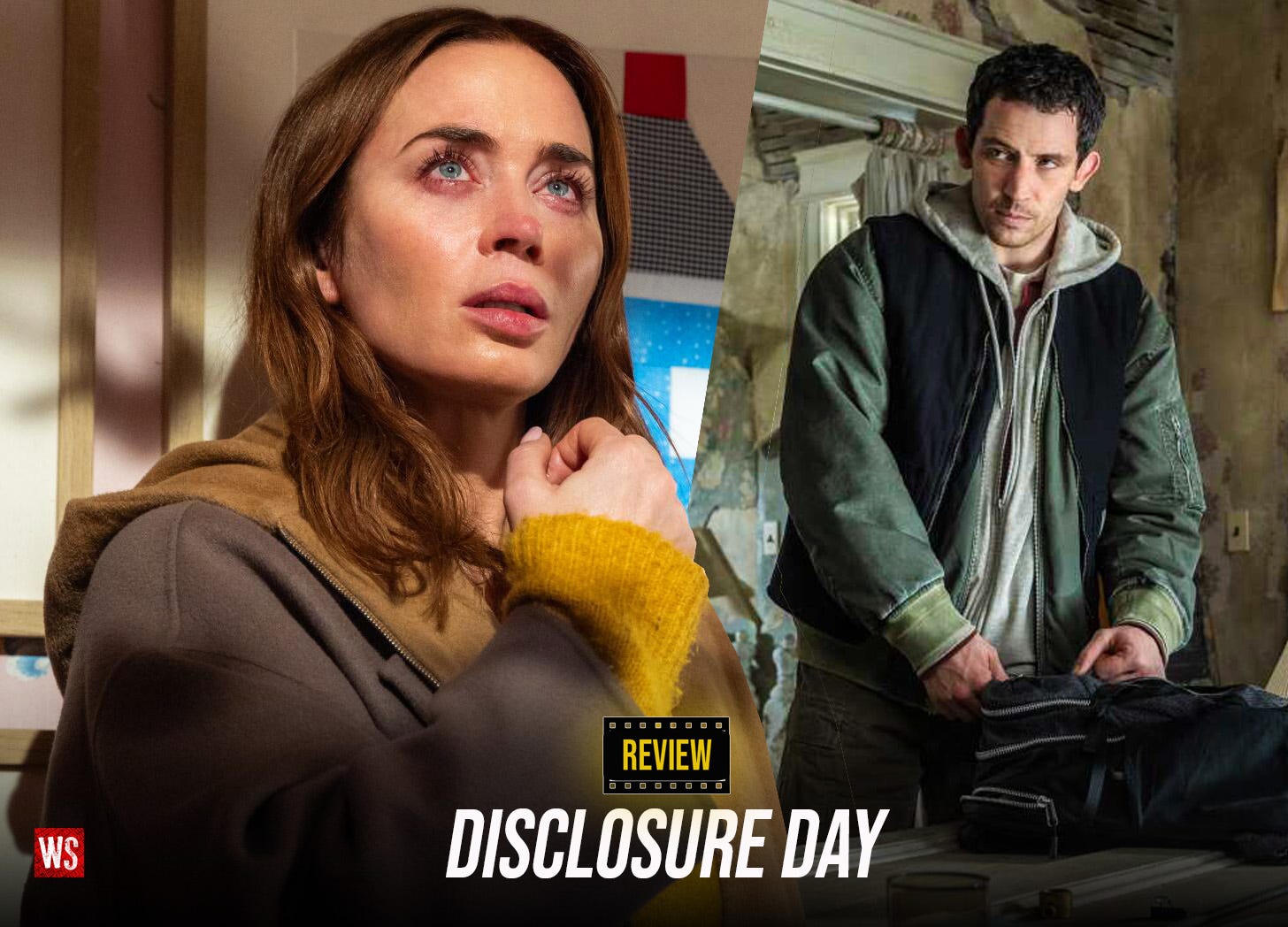
The film stars Emily Blunt as a local weather reporter who is “activated” at one point, presumably because the world is about to enter a vague WWIII scenario with North Korea. This piece of the story is meant to show the world is in chaos over the potential event happening, but mostly, we just see people hoarding at a gas station to sell that point.
Blunt is terrific here. Almost too terrific, really, as her performance is over-the-top in some aspects, feeling she’s acting her ass off in a more serious movie. You could take that as a compliment or a complaint about her performance, but she clearly showed up to give her all for a Spielberg film, and it mostly works.
Once “activated,” Blunt is suddenly able to “read” people, and it somehow leads her toward a whistleblower on the run from a non-government agency called WARDEX led by Colin Firth’s ruthlessly dedicated CEO. In a role I presumed would touch on remote viewing, stargates, or any of the many real-world aspects of these organizations, Spielberg instead uses the aforementioned device.
The device is a handheld alien device that allows the user all manner of strange abilities, chief among them entering someone else’s mind or even making themselves invisible. At one point, someone is teleported, but that event is all but ignored later, particularly at a moment when it would’ve been quite helpful for the protagonists.
Firth is a solid villain here, but could’ve been much more sinister had we gotten to know more about how he got to where he was and why he cared so much to keep things secret. We don’t need a life story for everyone involved, but a clear motive sure helps when trying to make sense of why people do what they do in any given plot.
The whistleblower character is played by Challengers’ Josh O’Connor, who exudes a solid man-on-the-run persona, but with a secret. His girlfriend, a former nun, is played with strong intensity by Eve Hewson (Bono’s daughter), but her arc is a wobbly one, as she represents the question of faith in a world that has confirmed non-human entities are real and among us, then disappears almost completely in the third act.
The concept of religion, God, and faith is certainly fascinating and worth exploring within the context of UAPs and non-human lifeforms, but it’s covered briskly and with little fanfare, wrapped up neatly with a Biblical quote.
For something that’s such a huge part of human existence, it feels like it should get more than a phone call.
Colman Domingo provides another solid performance to add to his resume, but it doesn’t quite reach the heights of his work on Euphoria or even Michael, for that matter. As the ringleader of the group fighting for disclosure, he’s something of an enigma as well, and I still can’t make heads or tails of his role within the film’s story. Perhaps that’s the point, but like most of the characters in the film, it just doesn’t feel like we know enough about who they really are to fully invest.
Still, Domingo continues to be a welcome presence in whatever project he appears in, and I hope that journey lasts a long time.
Written by Spielberg and frequent collaborator David Koepp, Disclosure Day is an oddly assembled film that wants to be something more meaningful and impactful, but is hamstrung by the chase plot that frequently ties up the story with things we’ve seen many times before (and done much better by all involved).
At this point, if you’re going to do a car chase, it had better be something truly special. From William Friedkin to Justin Lin to Spielberg himself, we’ve seen car chases done in nearly every fashion at this point (with props to Paul Thomas Anderson for taking a new swing at it in his recent film, One Battle After Another).
If we’re literally going down that road again, it needs to be something we’ve never seen before.
I think the audience’s interest is underestimated in that regard. Sure, we need a jolt here and there to keep things moving, and perhaps what Spielberg supplies in Disclosure Day is just enough, but for those of us who have a genuine thirst to see the real-world reports, stories, and speculation brought to life, it feels like a distraction.
There’s a lot of tease and build-up until the film’s finale, which shines a light on many real-world events but doesn’t say anything definitive or lead the audience to believe one thing or another, instead taking them to a door that can be opened and explored, or that could be left shut and ignored upon leaving the theater.
For many, I think it will leave the door shut, just as it will in real life. While the film dances around the idea of how disclosure will impact civilization on the whole, from daily life to religion to the question of existence, they sidestep the very real likelihood that many simply won’t care or won’t believe, no matter what you throw at them, right up to wheeling out an alien body on live TV.
I can hear it now: “That’s AI! Fake! Government conspiracy! A lie!”
When you start talking about things like stargates, inter-dimensional beings, simulated reality, etc., people’s heads start to spin, and Disclosure Day isn’t really interested in pushing the audience that far, ironically, as if they aren’t actually ready for real disclosure.
But perhaps that’s where Disclosure Day will succeed, as the trove of material out there is ripe for the picking. From decades (hell…centuries) worth of evidence, testimonials, and stories that seem too wild to believe, as well as the flood of newly released material from the U.S. Government, the thread is blowing in the breeze to be pulled.
But those like me who have studied this stuff for decades will find Disclosure Day to be fascinating only to a degree and well short of what it could have accomplished if it really leaned into the more convincing, scary, and hopeful aspects of what disclosure will no doubt bring when it truly arrives. There’s a bigger, better, and deeper story that could’ve been told with the elements that already exist with Disclosure Day, but we ultimately get the safe, predictable version.
For many, Disclosure Day will be a fun sci-fi romp, and maybe that’s enough for a trip to the movies. But if you’re looking for a movie that really goes for it and unearths the things that we know are out there, it will surely be a disappointment, even if it’s a well-crafted disappointment by a talented and influential filmmaker like Spielberg.